
Proposed Changes to Environmental Regulation Guidance on Who Can Hold an Authorisation, Public Participation, Types of Authorisations and Amendments to Standard Conditions for Registration Level Activities for Water, Waste and Industrial Activities
Types of Authorisations
The following sections of the consultation covers the following areas:
- Changes to our authorisation guidance.
- New regulated activities.
- New registration level activities and proposed Standard Conditions.
- Changes to activity descriptions for registration level activities.
- Changes to Standard Conditions, including Interpretation of Terms.
There are no changes proposed for the regulation of radioactive substances. These changes only apply to waste, water and industrial activities and for ease of use we have split them by regime.
There are four types of authorisations in the Environmental Authorisations (Scotland) Regulations 2018: General Binding Rules, Notification, Registration, and Permit. These are shown in Image 1 and explained in further detail below.
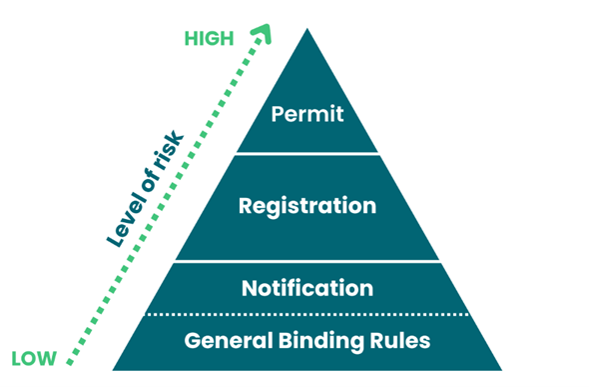
When proposing the type of authorisation required for each activity, SEPA have considered:
- Risk to the environment and human health.
- Legislative requirements.
- Fairness to the operator.
-
Public and third-party interests.
General Binding Rules (GBRs)
General Binding Rules (GBRs) are mandatory rules that apply to activities described in Schedule 9 of the Regulations. Providing the activity is carried out in accordance with these rules, SEPA would consider the activity as authorised. In most cases, there would be no requirement to contact SEPA.
Notifications
Notifications are for low-risk activities where SEPA does not need to decide whether to grant or refuse an authorisation, but we must be notified the activity is being carried out and by who.
Activities in this category will be authorised as soon as SEPA have received notification. In most cases, an activity that requires a Notification to SEPA, will also have to follow a General Binding Rule.
Unless specifically stated, Notifications do not expire. The authorisation is granted until it is surrendered by the authorised person.
Registrations
Registrations are for lower risk activities that require a simple assessment prior to SEPA deciding whether to grant or refuse the authorisation.
SEPA have 28 days to determine an application. If authorised, the Registration will be issued to the authorised person with Standard Conditions. Standard Conditions are a set of rules that apply to a particular activity and must be consulted upon before they are used. Once they have been published, they cannot be appealed. If the person wishing to undertake a registration activity cannot comply with the associated Standard Conditions, they must apply for a permit instead.
Unless specifically stated, Registrations do not expire. The authorisation exists until it is surrendered by the authorised person or revoked by SEPA.
Permits
Permits are for higher risk or non-standard activities. Permit applications are likely to require a rigorous assessment before SEPA decides whether to grant or refuse the authorisation.
If an activity requires a detailed Fit and Proper Person assessment, or involves a public consultation process, it will need a Permit authorisation.
A Permit may include Standard Conditions, and any other conditions that SEPA believe are required to mitigate the risk of environmental harm from the activity (these are referred to as bespoke conditions). Unless specifically stated, Permits do not expire. The authorisation exists until it is surrendered by the authorised person or revoked by SEPA.